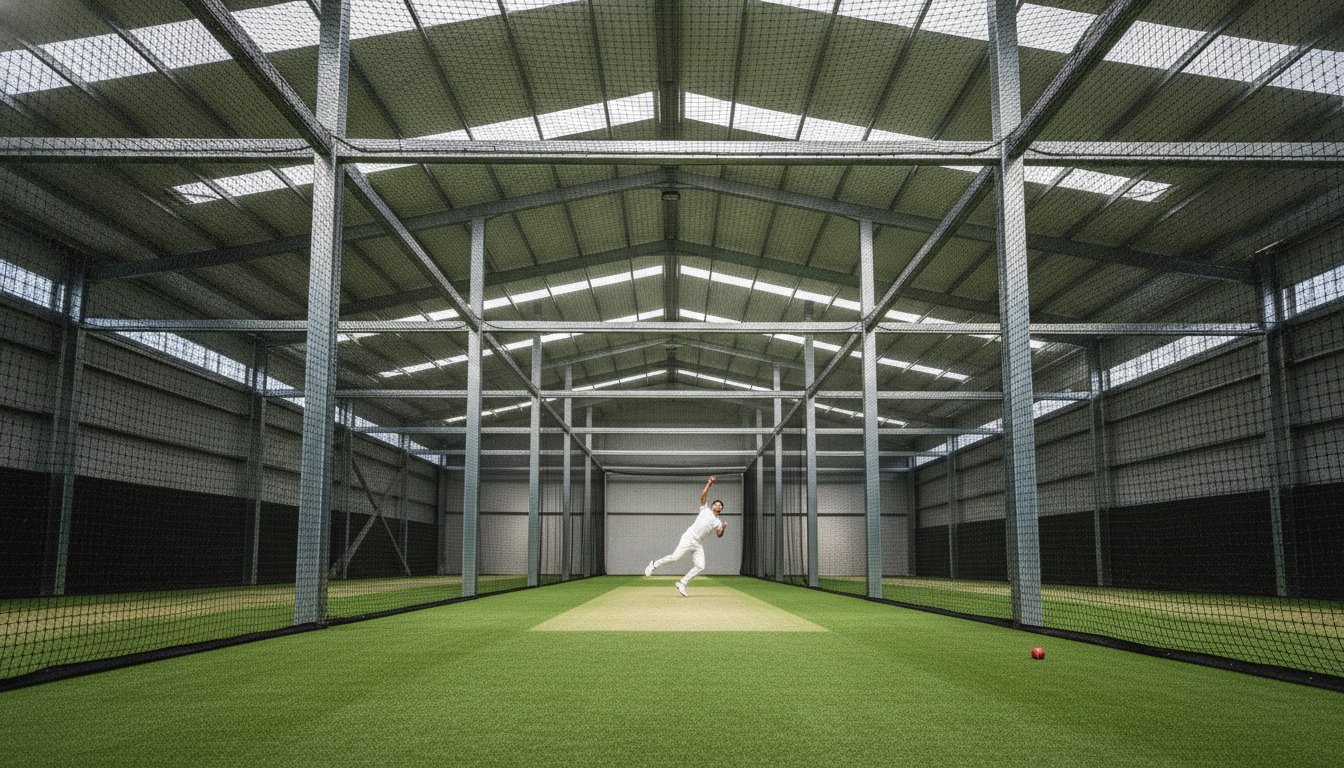
Professional Cricket Practice Net Design: The 2026 Expert Guide
Would you trust a fast bowler's delivery to a structure that might fatigue after just one season of heavy use? Many club secretaries and school coaches understand that a practice area is more than just netting; it's a vital investment in player development. However, the anxiety surrounding planning permissions and the dread of seeing a significant investment rust away can make the initial steps feel overwhelming. When you approach professional cricket practice net design, you aren't just buying a cage. You're building a foundation for the next generation of talent.
It's natural to worry about how a permanent structure fits into a limited footprint or whether it meets the stringent ECB TS6 performance standards. This 2026 expert guide provides the clarity you need to move forward with confidence. We'll show you how to design a high-performance facility that balances durability with space flexibility. You'll learn about the technical requirements for structural safety, the benefits of modern HDPE materials, and how to create a bespoke environment that serves your community for years to come.
Key Takeaways
- Understand why professional cricket practice net design begins with a thorough site assessment to ensure your facility handles local soil and drainage conditions effectively.
- Compare the durability of galvanised steel against aluminium to make an informed investment that resists metal fatigue and environmental wear.
- Identify the ideal configuration for your venue, whether you require the stability of a permanent fixture or the flexibility of a retractable system.
- Master the specific dimensions and surface requirements needed to create a professional-grade environment that complies with current safety regulations.
- Learn why expert installation is a non-negotiable step for securing insurance approval and ensuring the long-term safety of every player.
What Defines Professional Cricket Practice Net Design?
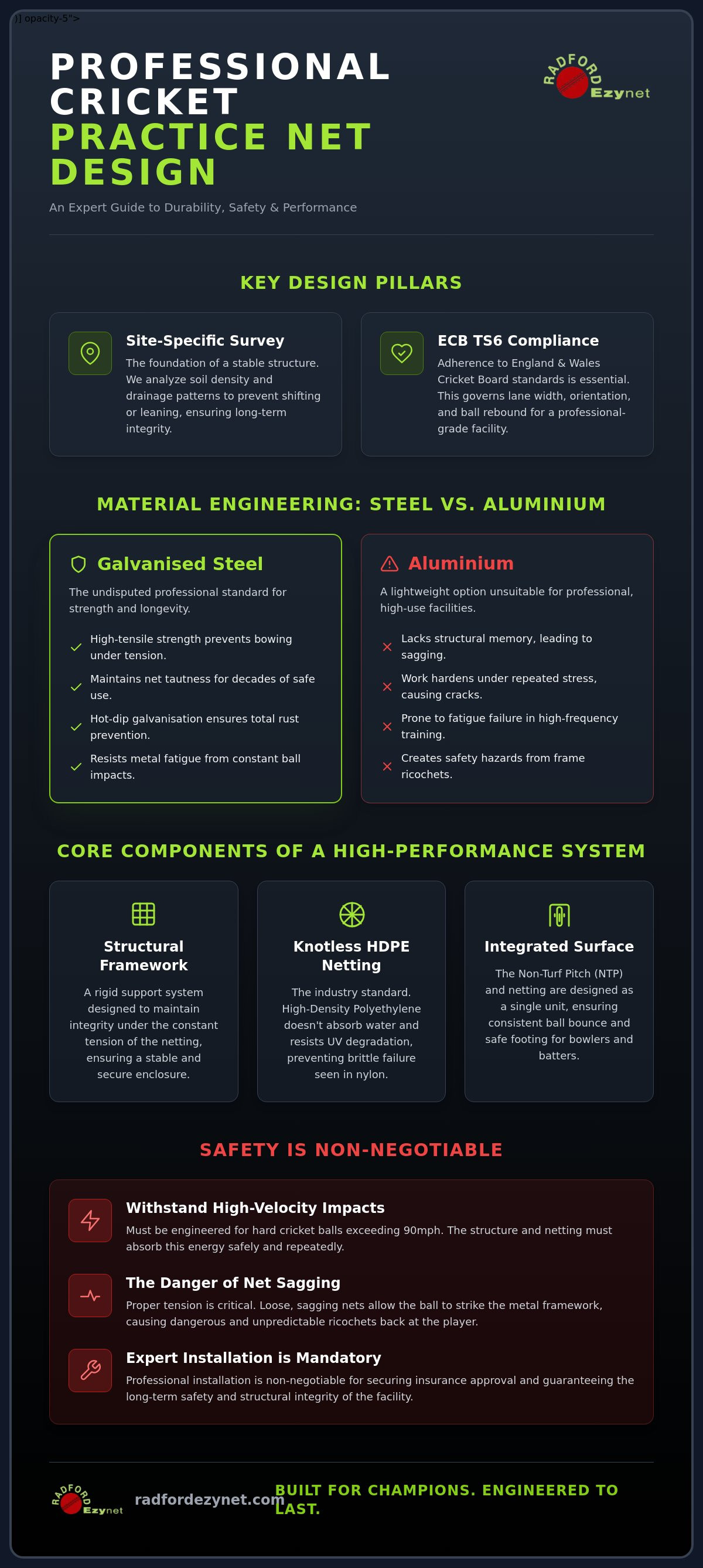
Professional cricket practice net design is a discipline that extends far beyond the basic installation of poles and mesh. While Cricket nets are common sights in back gardens and local parks, a professional-grade facility requires a level of engineering that ensures long-term safety and performance. A successful design starts with a comprehensive site-specific survey. We look at soil density and drainage patterns because the stability of the entire structure depends on the ground beneath it. If the foundations aren't matched to the specific geology of your site, even the highest quality steel will eventually lean or shift.
Adhering to England and Wales Cricket Board (ECB) standards, specifically the TS6 performance standards, is essential for any club or school seeking a durable result. These guidelines dictate everything from lane width to the specific orientation of the facility. Proper design manages how a ball reacts upon impact. It ensures that rebounds are predictable and that players remain protected from stray shots in adjacent lanes. When you invest in a bespoke layout, you're creating a controlled environment where coaches can focus on technique without worrying about structural failure.
The Core Components of a Professional Facility
The structural framework is the foundation of any high-performance system. We prioritise rigid support systems that maintain their integrity under the constant tension of the netting. For the mesh itself, knotless High-Density Polyethylene (HDPE) has become the industry standard over traditional nylon. HDPE doesn't absorb water and resists UV degradation, which prevents the brittle failure often seen in cheaper alternatives. Finally, we consider the integrated surface. A professional net and its non-turf pitch (NTP) must be designed as a single unit to ensure consistent bounce and safe footing for the bowler and batter alike.
Safety and Compliance Standards
Schools and local authorities have a significant duty of care toward their users. Professional cricket practice net design must account for high-velocity impacts from hard cricket balls, often exceeding 90mph in coaching environments. This requires specific tensioning techniques to prevent net sagging. When nets lose tension, they become dangerous. Loose netting allows the ball to strike the metal framework and ricochet back toward the batter at unpredictable angles. A well-engineered system maintains its tautness through years of heavy use, ensuring that safety isn't compromised by material fatigue or environmental wear.
Material Engineering: Why Structural Integrity Matters
Choosing the right materials is the most critical decision in professional cricket practice net design. While budget-friendly options often use lightweight alloys, these materials rarely withstand the rigours of high-frequency training. Professional facilities face constant vibration from ball impacts and the relentless tension required to keep netting taut. If the framework flexes too much, the netting sags. This creates a safety hazard where balls can strike the frame and ricochet at dangerous angles.
Aluminium is frequently marketed for its portability and weight. However, it lacks the structural memory of high-tensile steel. Over time, the repeated stress of balls hitting the net causes aluminium to work harden and eventually crack. This fatigue makes it unsuitable for professional academies where nets are used daily. In contrast, hot-dip galvanised steel provides the density and strength needed to maintain a perfectly vertical posture for decades, even under extreme tension.
British weather is notoriously hard on outdoor structures. To ensure a lifetime of service, professional frames must be protected by more than just a layer of paint. Hot-dip galvanisation involves dipping the steel into molten zinc. This creates a metallurgical bond that prevents rust from the inside out. It's the only way to guarantee the system survives wet winters without losing its structural integrity. If you're planning a new installation, exploring a bespoke cricket net system ensures your materials are matched to your specific usage requirements.
Steel: The Professional Gold Standard
High-tensile steel allows for significant tension to be applied to the net without the posts bowing inward. This tension is vital for ball containment; it ensures the ball drops dead rather than snapping back at the batter. We often add a secondary powder coating to the galvanised base to provide a clean, professional aesthetic that matches club colours. Steel remains the preferred choice for professional-grade posts because its superior density prevents the structural bowing and metal fatigue commonly seen in aluminium alternatives.
Netting Science: HDPE and UV Stabilisation
The netting itself is a feat of material science. Professional academies have moved away from nylon, which absorbs water and stretches when wet. Instead, knotless High-Density Polyethylene (HDPE) is the preferred standard. It's naturally hydrophobic and maintains its shape regardless of humidity. This ensures that the net doesn't become heavy or sag after a rainstorm.
UV stabilisation is incorporated during the manufacturing process to prevent the sun's rays from breaking down the polymer chains. Without this protection, nets become brittle and snap within two or three seasons. Standard mesh sizes are typically 50mm. This is small enough to stop a cricket ball while allowing enough airflow to reduce the wind load on the support posts. This balance is crucial for the stability of the entire system during high winds.
Fixed vs. Retractable: Choosing the Right Configuration
Choosing the right configuration is a balance between your available footprint and the frequency of use. When considering professional cricket practice net design, the decision between a fixed or retractable configuration depends entirely on your site's operational requirements. A dedicated cricket club with a permanent practice area will often favour a fixed-post system. These structures offer the highest level of stability and can be engineered to accommodate multiple bays, allowing dozens of players to train simultaneously. This throughput is vital for larger clubs during peak season.
Many schools and community centres don't have the luxury of a single-use cricket area. For these venues, the rise of retractable technology has changed the landscape. These systems allow for a high-performance practice environment that can be cleared away to make room for other sports or events. This flexibility ensures that your investment doesn't sit idle or obstruct other activities. The Radford EZY Net System™ is specifically designed to meet this need. It provides the same hard-ball robustness found in permanent cages but in a format that remains mobile and easy to manage. It's a professional-grade solution for spaces that require versatility without sacrificing player safety.
Bespoke Fixed Netting Systems
Fixed systems are the bedrock of established cricket grounds. When space is ample, we design multi-bay facilities that allow for structured coaching sessions across different age groups at the same time. These permanent installations require careful planning regarding orientation to manage sunlight and wind direction. For a deeper look into how these facilities are tailored to specific club needs, you can explore our guide on bespoke cricket netting systems. A well-designed fixed system becomes a central hub for player development, offering a predictable and reliable environment for years of service.
The Advantages of Retractable Technology
Retractable systems offer a unique set of benefits for shared community spaces and schools. Beyond the obvious advantage of multi-use flexibility, these systems provide a significant layer of security. In areas where vandalism or unauthorised use is a concern, being able to demount or retract the netting when the facility is not in use protects your investment from damage. Modern professional cricket practice net design has evolved so that these systems are no longer cumbersome. A well-engineered retractable system can be set up or stored by just two people in a matter of minutes. This ease of use ensures that practice sessions start on time and the equipment is stored safely at the end of the day, extending the lifecycle of the netting and the framework.
Planning Your Facility: Dimensions, Surfaces, and Regulations
Planning the physical layout is the next step once you've settled on your materials. Professional cricket practice net design requires more than just a 22-yard strip of turf. You need to account for the total footprint, which includes side safety margins and bowler approach zones. A standard lane should ideally be between 3.0m and 3.6m wide. Anything narrower restricts the batter's natural movement and increases the risk of the ball striking the side netting and rebounding at sharp angles. Height is equally important; a standard 3.6m height prevents high-lofted shots from escaping the enclosure and protects spectators.
Navigating planning permission is often a source of anxiety for club committees. Generally, permanent structures over a certain height or those positioned close to site boundaries require local authority approval. We suggest engaging with a specialist early to ensure your layout complies with local zoning laws and ECB TS6 standards. This proactive approach prevents costly delays or the need for mid-project modifications. Adhering to these dimensional standards is a hallmark of professional cricket practice net design, ensuring that every lane provides a realistic match-day experience. If you're ready to begin your project, you can contact our design team for a bespoke assessment.
Standard Professional Dimensions
A width of 3.6m is widely regarded as the gold standard for professional safety. It provides enough room for the batter to play expansive shots without fear of hitting the frame. Length is another critical factor. While the pitch itself is 20.12m, the overall facility length must include runoff space for the bowler. Without this, bowlers risk injury during their follow-through as they try to stop abruptly. For detailed layout templates and spatial planning, refer to our guide on cricket facility design and build.
Artificial Surface Selection
The surface you choose dictates the quality of the practice. Non-Turf Pitches (NTP) consist of a base, a shock pad, and a synthetic carpet. The shock pad is essential for absorbing energy and providing a consistent ball bounce that mimics a well-prepared grass wicket. If the surface isn't integrated correctly with the net framework, you may experience uneven wear at the crease. You can find more technical specifications in our ultimate guide to all-weather cricket pitches. High-quality groundworks ensure that water drains away quickly, keeping the facility playable even after heavy rainfall.
Implementing Your Bespoke Netting System
Implementing a professional cricket practice net design requires more than just mechanical assembly; it demands a deep understanding of structural tension and safety standards. While DIY kits might appeal to those looking for a quick fix, they often fail to meet the rigorous demands of club or school environments. A professional installation ensures your facility is compliant with insurance requirements and safety regulations. This is vital for protecting your players and your organisation from liability. When an expert team handles the build, every component is vetted for durability and performance.
Our process at Radford EZY Net is designed to be a "safe pair of hands" for your project. We move systematically through a proven implementation path:
- Site Survey: Verifying ground conditions and drainage requirements.
- Bespoke Manufacturing: Creating components tailored to your specific layout.
- Professional Installation: Precise assembly by our in-house specialists.
- Final Handover: A full walkthrough and safety briefing for your team.
By involving ex-professional players in our consulting phase, we provide insights that general contractors simply don't possess. We understand how a bowler approaches the crease and how a batter reacts to a ball's rebound. This expertise ensures the final facility isn't just a structure, but a high-performance coaching tool that truly serves the players' needs. This thoroughness is a hallmark of professional cricket practice net design, providing you with a secure, long-term investment.
The Installation Process
We don't believe in using subcontractors for our projects. Our in-house installation team carries the collective knowledge of our brand, ensuring that our high standards are met at every stage of the build. This direct control allows us to provide a comprehensive walkthrough and final safety inspection before we leave the site. That's how we guarantee that every post is set to the correct depth and every net is tensioned to professional standards. If you're currently vetting providers, it's helpful to understand what to look for in a choosing a cricket net installation company.
Longevity and Maintenance
Your facility is a long-term asset that deserves a full lifecycle of care. Professional cricket practice net design includes planning for the years after the initial build. Regular maintenance is the key to preventing material fatigue and ensuring the netting remains safe for use. We suggest an annual service schedule to check for tension loss and structural wear in the galvanised steel posts. During the winter months, following specific storage best practices will significantly extend the life of your HDPE netting. For a comprehensive look at how to protect your club's equipment, refer to our cricket net maintenance service guide. Taking these steps ensures your practice nets remain a stable, high-quality resource for the next generation of cricketers.
Building Your Legacy on Proven Foundations
Investing in a high-performance training facility is a commitment to the future of your club or school. We've explored how the right material choices and precise spatial planning form the bedrock of long-term safety and durability. By prioritising high-tensile steel and UV-stabilised HDPE, you ensure that your professional cricket practice net design withstands the rigours of both the British weather and high-velocity training sessions. Every detail, from the lane width to the sub-base drainage, contributes to a secure environment where talent can flourish.
Our team, led by ex-England cricketer Neal Radford, brings over 30 years of professional installation experience to every project. We combine this deep technical knowledge with our proprietary Radford EZY Net System™ technology to deliver facilities that are as flexible as they are robust. Whether you require a permanent multi-bay structure or a versatile retractable system, we provide a "safe pair of hands" from the initial site survey to the final handover. Consult with our experts for a bespoke cricket net design today and take the first step toward a world-class practice environment. Your players deserve a facility that matches their ambition.
Frequently Asked Questions
Do I need planning permission for professional cricket nets?
Generally, permanent structures over 4m high or those located near property boundaries require planning permission from your local authority. It's best to consult your local planning department before starting any professional cricket practice net design project. Smaller, temporary, or mobile systems like the Radford EZY Net System™ often fall under different regulations, but a quick check ensures your club remains compliant with local bylaws.
How long does a professional cricket net installation take?
A standard professional installation typically takes between three to five working days depending on the complexity of the groundworks. This timeline includes site preparation, foundation setting, and the final tensioning of the netting. Multi-bay facilities or those requiring extensive drainage work may take longer; however, our in-house team provides a clear project schedule during the initial survey to ensure minimal disruption to your training sessions.
What is the best material for cricket net posts?
Hot-dip galvanised steel is the industry standard for professional-grade posts due to its superior strength and resistance to metal fatigue. Unlike lighter alloys, steel maintains the high tension required for safe ball containment without bowing or cracking over time. This material choice provides a stable, long-term foundation that survives the British climate for decades, offering a secure return on your investment.
Can professional cricket nets be moved or retracted?
Yes, professional systems can be designed for mobility or retraction to accommodate multi-use spaces. Systems like our Radford EZY Net System™ allow for the robustness of a hard-ball cage in a format that staff can easily move or store. This flexibility is essential for schools and community centres that need to clear the field for other sports while maintaining a high-performance training environment.
What are the standard dimensions for a professional cricket lane?
A professional cricket lane should ideally be 3.6m wide and 3.6m high to ensure player safety and comfort. While the pitch itself is 20.12m, the total length of the enclosure should allow for bowler runoff and follow-through space. Adhering to these dimensions is a core part of professional cricket practice net design, as it prevents dangerous ball ricochets and provides a realistic match-day experience.
How often should professional cricket nets be inspected?
You should inspect your netting and framework before every practice session and conduct a formal structural review at least once a year. Regular checks help identify minor issues like net sagging or loose fittings before they become safety hazards. Our maintenance services include annual re-tensioning and structural audits to ensure your facility remains compliant with current safety standards and insurance requirements.
Is it better to use steel or aluminium for outdoor cricket cages?
Steel is significantly better than aluminium for outdoor cricket cages because it does not suffer from work hardening or fatigue under constant ball impact. While aluminium is lighter, it often flexes and eventually cracks at the joints when subjected to the high-tension loads required for professional netting. Galvanised steel provides the rigid stability needed to keep nets taut and players protected year-round.
What type of netting is best for hard-ball cricket practice?
Knotless High-Density Polyethylene (HDPE) is the best material for hard-ball practice because it is hydrophobic and UV-stabilised. Unlike nylon, HDPE doesn't absorb water or stretch when wet, which prevents the net from becoming heavy and sagging. A 2.0mm or 2.5mm twine thickness with a 50mm mesh size offers the ideal balance of strength and visibility for professional academies and clubs.


