Funding for School Cricket Facilities: The 2026 Comprehensive Guide
With the Department for Education committing £1 billion to school sports and the ECB launching a £45 million Strategic Facilities Fund in April 2026, there's a significant opportunity to upgrade your school's athletic infrastructure. Most school leaders recognize that providing professional-grade equipment is vital for student development, yet the path to securing funding for school cricket facilities often feels like a maze of complex criteria and strict safety standards. You're likely balancing the need for durable equipment with the reality of limited budget and multi-use space constraints.
This guide simplifies that process. It'll show you exactly how to access the latest government grants and ECB schemes to finance professional-grade cricket nets and pitches that stand the test of time. We'll explore the practical differences between fixed and mobile system costs, detail the specific eligibility requirements for the 2026 to 2028 funding cycle, and help you select equipment that meets every ECB safety regulation while maximizing your available field or hall space. By the end of this article, you'll have a clear, step-by-step roadmap to transform your school's cricket provision into a long-term community asset.
Key Takeaways
- Identify the primary 2026 UK government and ECB grant opportunities currently available to state schools and SEND settings.
- Learn how to navigate the specific criteria for funding for school cricket facilities, including eligibility for the ECB County Grant Fund and Chance to Shine programs.
- Understand why versatile, multi-use assets like the Radford EZY Net System™ are often preferred by funding bodies for maximizing limited school space.
- Follow a professional preparation process to eliminate guesswork in your application and align your project goals with national sport strategies.
- Gain insights into partnering with established industry specialists to ensure long-term durability and full compliance with ECB safety standards.
Navigating the 2026 Funding Landscape for School Cricket Facilities
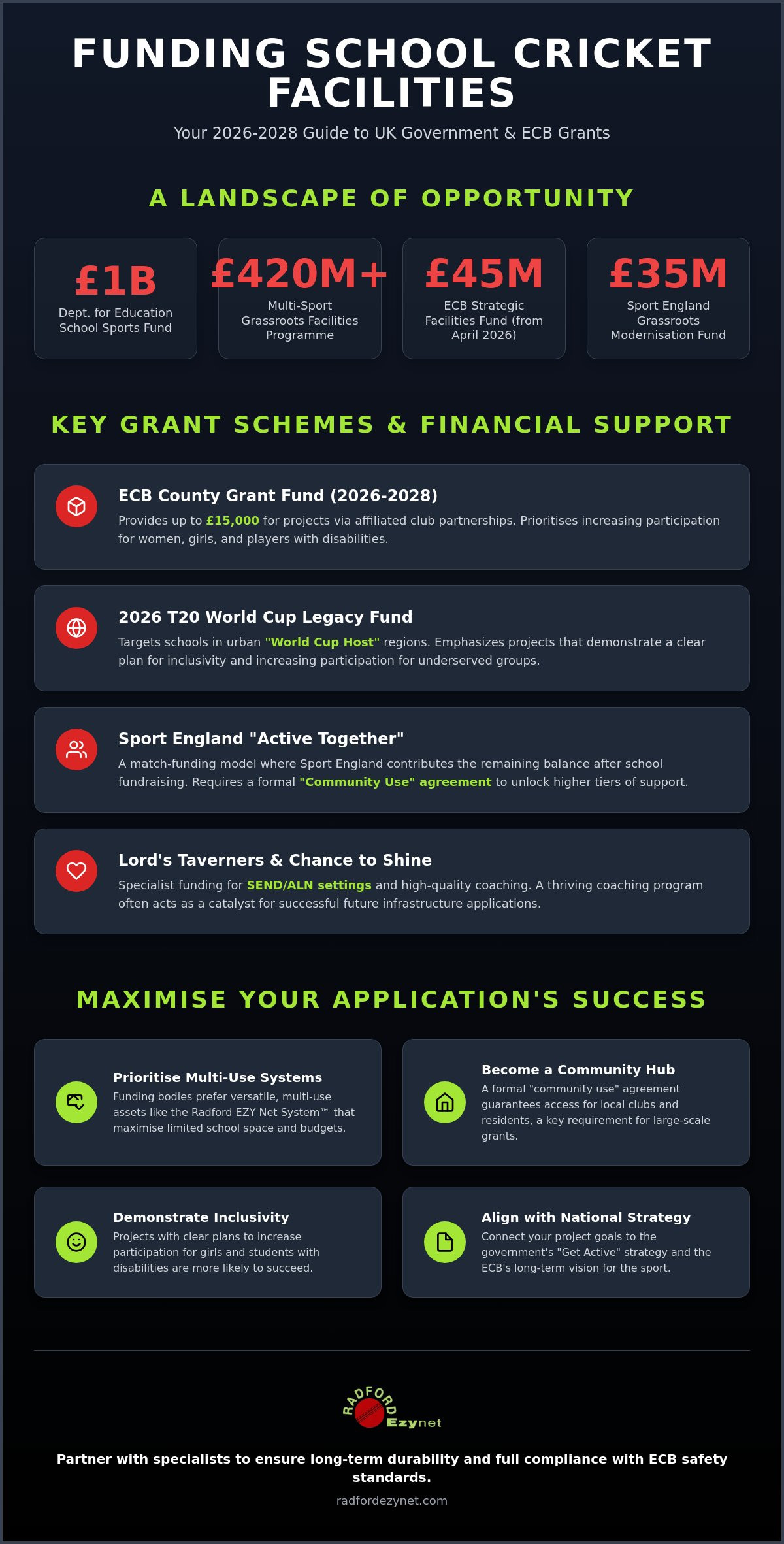
The UK government’s "Get Active" strategy has fundamentally changed how schools approach athletic investment. By 2026, the focus has shifted toward creating sustainable, high-quality environments that serve both students and the wider community. Central to this is the £35 million grassroots fund administered by Sport England. This specific pot of money targets the modernization of facilities, particularly in state schools where participation rates have historically lagged. It aligns with the Department for Education’s broader £1 billion investment in school sport, which includes nearly £200 million specifically for facility improvements. While some earlier funding announcements faced scrutiny regarding their security, the current Multi-Sport Grassroots Facilities Programme has provided a more stable foundation, delivering over £420 million for improvements through 2026.
This shift isn't just about general fitness. It's a strategic move to integrate schools into the long-term vision of the England and Wales Cricket Board (ECB). The ECB now views school grounds as the primary engine for growth in the sport. By investing in professional-grade infrastructure, schools can bridge the gap between casual PE lessons and competitive club cricket. Schools are no longer viewed as isolated islands but as vital hubs in the national cricket network. This makes securing funding for school cricket facilities a realistic goal for institutions that can demonstrate a commitment to long-term player development.
The Role of Sport England and the National Lottery
National Lottery funding remains a cornerstone for schools seeking funding for school cricket facilities. The current "Active Together" model uses a match-funding approach. This means if a school can raise a portion of the capital through local fundraising or internal budgets, Sport England can provide the remaining balance. To unlock the highest tiers of this support, schools usually need a "community use" agreement. These formal documents guarantee that local clubs or residents can access the nets outside of school hours. This turns a private asset into a community hub, which is a key requirement for many large-scale grants. It ensures the investment provides value well beyond the school day.
The 2026 T20 World Cup Legacy Fund
The 2026 T20 World Cup has created a specific legacy fund designed to leave a lasting impact on the sport's infrastructure. Schools located in urban "World Cup Host" regions are being prioritized for these grants. The fund places a heavy emphasis on inclusivity. Projects that demonstrate a clear plan to increase participation among girls and students with disabilities are more likely to succeed. This aligns with the ECB’s ambition to offer all 1,500 SEND education settings the opportunity to play cricket by 2028. Application windows for the 2026 season typically open in the preceding autumn, so early preparation is essential. Aligning your project with these legacy goals ensures your school isn't just buying equipment, but participating in a national movement to diversify the game.
Key Grant Schemes and Financial Support for Education
Securing funding for school cricket facilities often requires a multi-faceted approach. While government funds provide a broad foundation, specific grants from cricket-governing bodies offer more targeted support. The ECB County Grant Fund is a primary example. Between 2026 and 2028, this fund allows affiliated clubs to apply for grants up to £15,000. Schools that maintain strong partnerships with local clubs can often benefit from these investments, particularly if the project prioritizes cricket for women, girls, or players with disabilities. This collaborative model ensures that new facilities don't just sit idle during holidays but serve as a year-round community asset.
For schools with a heavy focus on inclusivity, the Lord’s Taverners provide essential support. By February 2026, their programs reached over 28,500 pupils across more than 950 SEND and ALN settings. Their funding often targets specialized equipment and facilities that make the game accessible to every student. Similarly, organizations like Chance to Shine offer funding for high-quality coaching. While this is primarily an operational grant, successful coaching programs frequently act as a catalyst for future infrastructure bids. When a school proves it has a thriving cricket culture, it's in a much stronger position to request capital for permanent installations.
If your school is an academy or part of a larger trust, interest-free loans represent a sustainable alternative to traditional grants. The England and Wales Cricket Trust offers loans up to £50,000 with a five-year repayment term. This is particularly useful for capital projects like high-quality practice nets. It allows you to install professional-grade equipment immediately while spreading the cost across several academic budgets. To ensure you're choosing the most durable and compliant systems for your space, it's often helpful to review technical specifications with an industry specialist before submitting your financial proposal.
Condition Improvement Fund (CIF) for Academies
The Condition Improvement Fund (CIF) is a vital resource for academies and sixth-form colleges. To succeed here, you should frame your cricket facility project as an essential improvement to the school estate. Focus on how new, safe netting systems replace aging, potentially hazardous equipment. Aligning your bid with "health and safety" or "facility expansion" goals often yields better results than a purely "sports-focused" application. Deadlines usually fall in late December or early January, so starting your site surveys in the autumn is critical for a robust bid.
Section 106 and CIL Funding
Local authorities often hold funds from housing developers, known as Section 106 agreements or Community Infrastructure Levy (CIL) payments. If your school is near new residential developments, these funds can be unlocked for local sports infrastructure. It's essential that your school is featured on the Local Authority "Playing Pitch Strategy" (PPS) map. Being on this map identifies your site as a priority for development. Engaging with your local planning department early can help you secure a portion of these developer contributions for your next facility upgrade.
Maximising Value: Why Multi-Use Systems Secure More Funding
Grant bodies increasingly prioritize projects that offer high utility and long-term durability. When evaluating applications for funding for school cricket facilities, auditors look for versatile assets that don't permanently obstruct multi-use school spaces. A fixed cage on a playground might prevent other activities, making it less attractive to a broad-spectrum grant provider like Sport England. In contrast, systems that can be moved or retracted demonstrate a "smart" use of space. This flexibility is a significant advantage when competing for limited funds, as it ensures the facility remains a benefit rather than a hindrance to the school's daily operations.
Choosing the right materials is equally vital for securing long-term financial support. While aluminium frames might seem like a cost-effective alternative, they're often prone to fatigue and damage in high-use school environments. Professional-grade steel posts provide the necessary robustness to withstand regular use with hard cricket balls, meeting the strict safety standards set by the ECB. Demonstrating that your chosen equipment has a long lifecycle reduces the perceived risk for the funding body. It shows that their investment won't require replacement in a few years, but will instead serve generations of students.
The Radford EZY Net System™ Advantage
The Radford EZY Net System™ offers a bespoke solution that bridges the gap between indoor and outdoor training. Its design allows for a seamless transition, meaning a single investment can serve multiple environments. Because the system is mobile, it often avoids the lengthy planning permission delays associated with permanent structures. This speed of implementation is highly valued by grant auditors who need to see funds utilized within specific windows. The system is designed by ex-England cricketer Neal Radford, providing an authoritative level of professional vetting that reassures decision-makers of its quality and safety.
Indoor vs. Outdoor Funding Priorities
In 2026, there's a renewed focus on year-round participation, evidenced by the national initiative to deliver 16 state-of-the-art cricket domes. Indoor facilities often attract higher levels of funding for school cricket facilities because they eliminate the barrier of seasonal weather. To create a "complete" and more competitive bid, schools should consider how their netting system integrates with artificial surfaces. A comprehensive proposal that includes both professional-grade nets and a durable playing surface presents a turnkey solution to funding bodies. This holistic approach proves that the school has considered every detail of the player experience, from safety to performance.
How to Prepare a Successful Funding Application
A successful application for funding for school cricket facilities requires more than just enthusiasm; it demands meticulous preparation and technical accuracy. Grant bodies, particularly the ECB and Sport England, prioritize projects that are "shovel-ready" and financially sound. You'll need to align your school’s objectives with the specific target groups identified in the 2026 to 2028 funding cycle, such as increasing participation for women, girls, and players with disabilities. Demonstrating a clear understanding of your project’s total cost of ownership is essential. This includes not just the initial purchase, but a documented long-term maintenance plan that ensures the facility remains safe and functional for years.
To build a credible budget, you must secure multiple quotes from experienced cricket net contractors UK who understand the nuances of school environments. Auditors look for social proof, so include testimonials from local clubs or statements from your PE department regarding the anticipated impact on student wellbeing. By providing a comprehensive vision that combines technical feasibility with community benefit, you significantly increase your chances of approval. Each step of the process should build a cumulative sense of trust with the funder, showing that their investment is in a safe pair of hands.
The Importance of a Professional Site Survey
Guesswork is the enemy of a successful grant bid. A professional site survey assesses critical factors like soil composition, natural drainage, and potential underground obstructions that could inflate costs later. Radford EZY Net provides free site inspections to ensure your initial quote is accurate and realistic. This thoroughness is vital because it proves to auditors that you've accounted for every technical detail. Conducting a thorough technical assessment before applying prevents costly mid-project grant variations that can stall installation and damage your relationship with funding bodies.
Building the "Community Use" Case
Most major grants are unlocked when a school demonstrates its facility will serve the wider public. Drafting a Memorandum of Understanding (MoU) with a local cricket club is a powerful way to prove this commitment. This agreement outlines how the club will use the nets during evenings and weekends, turning your school into a regional hub for the sport. When your application links these partnerships to bespoke cricket netting systems designed for high-performance training, it signals to auditors that you're investing in a top-tier, academy-level environment. To begin your application with a precise technical foundation, you can book your professional site survey today.
Partnering with Radford EZY Net for Your School Project
Selecting a partner for your installation is just as critical as the application itself. Radford EZY Net brings over 30 years of industry-leading expertise, led by former England international Neal Radford. This history provides a level of technical depth that ensures your project meets the rigorous standards required by national governing bodies. We maintain full, end-to-end accountability for every project. This journey starts with our professional site survey and concludes only after a comprehensive final walkthrough and handover. You're not just buying equipment; you're investing in a relationship with an authoritative specialist.
We never use subcontractors. Our dedicated in-house teams handle every stage of the installation process. This approach guarantees that the quality of work remains consistent and fully compliant with the grant criteria you've worked hard to meet. It also ensures that the "safe pair of hands" we promise is the one actually performing the work on your grounds. Beyond the initial build, we provide a full lifecycle of care through insured cricket net maintenance and inspection. This ongoing support protects your school's long-term asset and ensures students always have a safe, professional environment for practice.
Bespoke Solutions for Every School Budget
Every institution has unique spatial and financial requirements. We specialize in tailoring net sizes and materials to fit within the specific award limits of your funding for school cricket facilities. By focusing exclusively on steel construction, we offer a level of durability and stability that lighter alternatives simply cannot match. This commitment to professional standards has made us the trusted partner for prestigious institutions like St Paul’s and Judd Grammar. These schools required facilities that could withstand heavy daily use while maintaining academy-level performance; our bespoke designs delivered exactly that.
Next Steps: From Consultation to Handover
Starting your project is a straightforward, methodical process. It begins with a free, no-obligation site consultation where we assess your grounds and discuss your specific goals. Our team then guides you through the complexities of cricket facility design and build, ensuring every detail aligns with your funding application requirements. We provide the technical documentation and social proof needed to strengthen your bid and build trust with auditors. Contact Radford EZY Net today to start your funding journey and secure a professional-grade future for your school's cricket program.
Building a Lasting Legacy for Your Students
The 2026 funding landscape offers a unique window to transform your athletic provision through specialized funding for school cricket facilities. By aligning your project with national inclusivity goals and prioritizing durable, multi-use infrastructure, you create a compelling case for long-term investment. Success in this process relies on moving away from guesswork and toward professional technical standards that satisfy both grant auditors and safety inspectors. Choosing the right equipment today ensures your school remains a hub for the sport for decades.
Radford EZY Net provides the stability and expertise needed to navigate this journey with confidence. Led by former England International Neal Radford, our team brings over 30 years of professional installation experience to your project. As a provider approved by Cricket South Africa (NPC), we ensure every bespoke installation meets the highest international standards for safety and performance. We're here to act as a dependable partner from your initial application to the final handover. You can take the first step toward a professional-grade facility today.
Request a Free Site Survey for Your School Facility
We look forward to helping you build a safe, high-performance environment where your students can thrive for years to come.
Frequently Asked Questions
Can state schools apply for the new £35m government cricket fund?
State schools are a primary target for the £35 million grassroots investment administered by Sport England in 2026. These funds are specifically designated to improve infrastructure in educational and community settings where participation is currently low. To succeed, your school usually needs to demonstrate a partnership with a local cricket club or provide a "community use" agreement that allows the facility to be used outside of standard school hours.
Do we need planning permission for outdoor school cricket nets?
Mobile and retractable systems often don't require formal planning permission because they aren't classified as permanent structures. However, large-scale fixed cages or permanent "bowling ends" may require a planning application depending on your local authority's height and boundary regulations. Conducting a professional site survey early in the process helps identify any potential planning hurdles before you commit to a specific design.
What is the difference between fixed and retractable cricket net systems for schools?
Fixed systems consist of permanent steel cages that remain in place year-round, while retractable systems like the Radford EZY Net System™ can be moved or stored when not in use. Retractable systems are often preferred when applying for funding for school cricket facilities because they don't permanently obstruct multi-use playgrounds or sports halls. This versatility allows schools to maximize their available space for various sports without compromising on the quality of their cricket provision.
How much does a professional school cricket net installation cost?
The cost of a professional installation depends on several bespoke factors, including the number of lanes, the choice of netting material, and the specific ground conditions of your site. Factors such as soil drainage and the need for artificial surfacing also influence the final budget. Because every school environment is unique, we recommend a technical site inspection to provide an accurate quote that you can use for your grant application.
Is there funding available for repairing existing school cricket surfaces?
Funding for the modernization and repair of existing facilities is available through the ECB County Grant Fund and the Multi-Sport Grassroots Facilities Programme. These bodies often prioritize the "enhancement" of current assets to ensure they meet modern safety and performance standards. If your current nets or surfaces have become a health and safety concern, framing your application as an essential facility improvement can increase your chances of securing financial support.
What are the ECB standards for school cricket practice facilities?
ECB standards focus on safety, durability, and performance, requiring facilities to be robust enough for hard-ball use. These specifications cover everything from net mesh strength and wire tension to the specific safety margins required between lanes. Using equipment that has been professionally vetted ensures your school remains compliant with national safety regulations. This professional approval is often a mandatory requirement for any project receiving funding for school cricket facilities.
Can we use PE and Sport Premium funding for cricket net installation?
Schools can use their PE and Sport Premium allocation for the installation of cricket nets, provided the investment leads to sustainable improvements in the quality of PE and sport. The Department for Education encourages using this premium for capital projects that build long-term capacity rather than just covering day-to-day running costs. Installing professional-grade equipment that serves multiple year groups for over a decade is a clear example of a sustainable, high-impact investment.
How long does a professional cricket net system last in a school environment?
A professional-grade system built with high-quality steel posts and durable netting can last 10 to 15 years or more with regular maintenance. Systems designed for school environments are specifically engineered to withstand heavy daily use and variable weather conditions. Choosing a system with a proven lifecycle helps prove the "value for money" case to grant auditors, as it demonstrates that their investment will benefit the school community for many academic cycles.


