Common Cricket Facility Planning Mistakes: A Professional Guide for 2026
Would you gamble £40,000 of your club’s hard-earned funds on a practice facility that might only last two seasons? For many committees, the fear of making common cricket facility planning mistakes is a significant barrier to ground improvements. You want a high-performance environment where players can safely hone their skills, but the complexities of ECB compliance and planning permission often feel like a minefield. It's understandable to feel anxious about liability and longevity when construction costs are forecasted to rise by 2.7% in 2026.
We believe that every installation should be a secure, long-term investment that provides peace of mind. This guide will show you how to avoid the costly design and material errors that compromise safety and performance in new cricket net systems. You'll learn how to navigate the latest safety standards and site-specific engineering requirements for your specific project. We will explore the critical steps to securing a durable facility that maximizes your ground space and serves your community for 30 years or more.
Key Takeaways
- Learn why a professional site survey is the only way to prevent unexpected technical failures and budget overruns during construction.
- Discover why choosing high-grade materials like hot-dip galvanised steel ensures your facility remains stable and safe for over 30 years.
- Avoid common cricket facility planning mistakes by mastering the North-South orientation rule to protect players from dangerous sun glare.
- Understand how retractable systems like the Radford EZY Net System™ provide the flexibility needed for multi-sport grounds and efficient out-of-season maintenance.
- Gain clarity on navigating UK planning permission and the essential aftercare schedules required to maintain long-term ECB compliance.
The Guesswork Trap: Why Skipping a Site Survey is the #1 Mistake
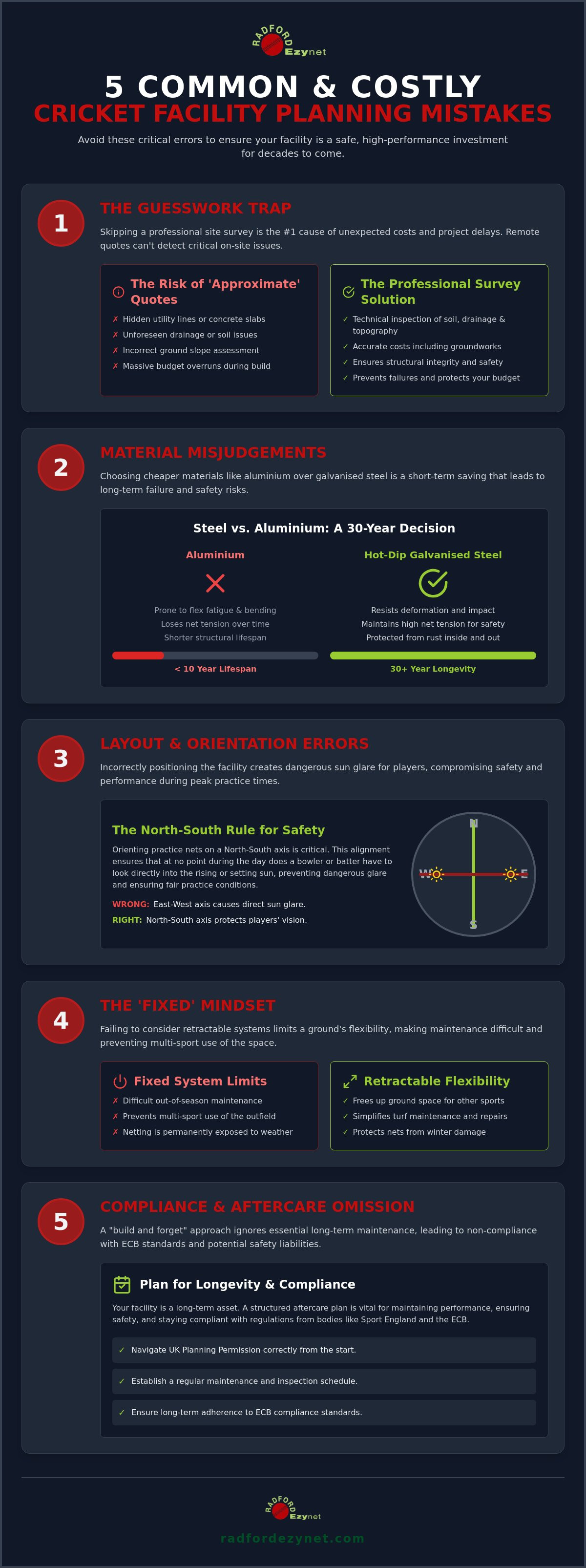
Starting a project without a physical inspection is the fastest way to drain a club's budget. A site survey isn't just a quick look at the grass; it's a technical inspection of soil density, drainage capacity, and topography. Relying on remote quotes based on satellite imagery is one of the most common cricket facility planning mistakes we see. Google Maps can't detect underground utility lines, legacy drainage pipes, or the exact slope of the ground. When the construction team arrives and hits a hidden concrete slab or a high water table, the "approximate" price you were quoted suddenly balloons. These unforeseen obstacles can stall a project for weeks, leading to massive budget overruns during the build phase.
The Danger of 'Approximate' Quotes
Generic pricing usually assumes a perfectly flat, clear site. In reality, most school and club grounds have subtle gradients that affect how nets are tensioned and how posts are installed. A professional cricket facility design and build approach accounts for essential groundworks like excavation and waste removal from the very beginning. Without this foresight, your club might face thousands in unbudgeted costs for soil disposal or land leveling. Topography also dictates ball containment; if the ground slopes away, your netting height must be adjusted to prevent balls from escaping under the bottom wire and creating a safety hazard.
Assessing Drainage and Ground Conditions
Drainage is the foundation of performance and longevity. Standing water is a silent killer for artificial surfaces because it rots the sub-base and causes the carpet to shift over time. During a physical survey, specialists test for soft spots that lead to uneven bounce and potential player injury. Understanding how different cricket ground components interact helps in identifying where surface runoff will collect. Soil type is equally critical to the structural integrity of the installation. Heavy clay requires deeper ground sockets and reinforced foundations compared to sandy loam. Failing to account for soil density is another of the common cricket facility planning mistakes that leads to structural failure. Without the right foundations, your posts may start to lean or "heave" after the first heavy frost, compromising safety and the long-term stability of the entire system.
Material Misjudgements: The Hidden Cost of Aluminium and Cheap Netting
Choosing materials based on the lowest initial price is one of the most common cricket facility planning mistakes. It's a short-term saving that often leads to premature structural failure. Many clubs fall for the "Aluminium Myth", believing that because it's lightweight and rust-proof, it's the ideal choice for netting posts. While aluminium has its place in portable equipment, it lacks the structural density required for a high-performance practice system. Over a decade of heavy use, aluminium posts suffer from flex fatigue. Every time a ball strikes the frame or high winds catch the netting, the metal undergoes minute stresses. Eventually, these stresses lead to permanent bending or hairline fractures that compromise the entire structure.
We insist on hot-dip galvanised steel for the Radford EZY Net System™ to ensure 30+ year longevity. This process involves dipping the steel into molten zinc, which creates a protective layer inside and out. Simple powder coating isn't enough for the damp UK climate; it can chip and allow rust to spread unseen beneath the surface. Galvanised steel provides the rigid stability needed to maintain high net tension, which is a core requirement in the Sport England design guidance for sustainable sports infrastructure. When your posts don't flex, your netting doesn't sag, and your players stay safe.
Why Steel Outperforms Aluminium in Cricket Environments
Steel's primary advantage is its resistance to deformation. In a busy school or club environment, a practice cage might face thousands of high-velocity ball strikes every month. Steel absorbs this energy without losing its shape. Aluminium, being softer, often develops "dents" or bows over time. Once a post begins to lean, it's almost impossible to return it to its original tension. This loss of tension is one of the common cricket facility planning mistakes that creates dangerous ricochets. A rigid steel frame ensures the system remains upright and professional for decades, not just seasons.
Specifying High-Performance Netting
Netting is your primary safety barrier, yet it's often where budgets are cut. Cheap knotted nylon nets are highly susceptible to UV "rot". Within two or three years of exposure to the sun, the fibres become brittle and can snap upon impact. We recommend knotless High-Density Polyethylene (HDPE) because it's naturally weatherproof and UV-stabilised. Knotless netting is also superior because it doesn't have the protruding "knots" that act as friction points. This reduces snagging and prevents the mesh from tearing under the stress of a hard-ball strike. Learning how to identify durable cricket practice nets will save your club from the recurring cost of replacement every few seasons.
If you are looking to invest in a system built for the long term, you can explore our high-specification installation options here. Selecting the right materials today prevents the safety hazards and financial headaches of tomorrow.
Layout and Orientation Errors: Positioning for Safety and Performance
Positioning a practice area is more than a logistical puzzle; it's a safety imperative. One of the most overlooked common cricket facility planning mistakes involves ignoring the sun's trajectory. If you place your nets without considering light angles, you risk creating a facility that's unusable or even dangerous during peak training hours. Beyond the sun, the physical footprint must account for the movement of people and heavy machinery. A facility that's "boxed in" by boundaries or buildings often leads to maintenance headaches and safety hazards for passers-by.
Optimal Pitch Orientation for Player Safety
The North-South rule is the gold standard for cricket ground design. Orienting the pitch so the bowler and batsman face North or South ensures the sun stays to the side of the field of play. An East-West orientation is a dangerous error. During late afternoon sessions, typically between 5 PM and 8 PM, the sun sits low on the horizon. This creates a blinding glare for either the batsman or the bowler. When a player can't track the ball's flight due to sun-glare, the risk of impact injuries increases significantly. Correct positioning ensures that your club or school can safely host training sessions throughout the summer evenings without compromising player visibility.
Designing for Multi-Bay Efficiency
Standard dimensions for club-level bays usually require a minimum width of 3.6 metres. Professional academies often prefer 4 metres to provide a more realistic match-feel. Narrow bays are a frequent error in budget-conscious projects. They compromise a bowler's run-up and restrict a batsman's ability to play horizontal-bat shots like the cut or pull. If your ground has an irregular shape, don't force a "cookie-cutter" cage into a space where it doesn't fit. Integrating bespoke cricket netting systems allows you to utilise awkward corners while maintaining the necessary safety margins between lanes. This prevents "cross-over" ball paths where a ball hit in one lane could potentially strike a player in the next.
Safety planning must also extend beyond the netting. You need to establish "no-go" zones for spectators and pedestrians. A high-velocity ball can occasionally deflect through or over a net, so keeping footpaths at a safe distance is essential for public liability protection. Finally, never forget maintenance access. Your grounds team will need enough clearance for mowers and heavy rollers to pass around the perimeter. If the space is too tight, the grass around the facility will quickly become overgrown and unsightly, eventually leading to drainage issues that we discussed in previous sections.
The 'Fixed' Mindset: Failing to Consider Retractable Flexibility
Many decision-makers assume that a permanent, fixed structure is the only way to ensure quality and durability. However, committing to a static cage is one of the common cricket facility planning mistakes that limits how you use your land. A fixed facility occupies the same footprint 365 days a year, regardless of the season or the sport being played. This "fixed" mindset often creates friction between different sports departments in schools or prevents ground staff from maintaining the outfield effectively. When a facility is permanent, it's also a constant target for vandalism or unauthorized use during the off-season.
The Radford EZY Net System™ was engineered to provide the stability of a professional permanent installation with the flexibility of a fully retractable solution. By using a demountable system, you gain a significant security advantage. Nets and poles can be removed and stored safely when they aren't in use, which drastically reduces the risk of theft or damage in public-access areas. This level of protection ensures your investment remains secure and functional for the long term, rather than being left exposed to the elements or anti-social behaviour during the winter months.
Maximising Multi-Use Games Areas (MUGAs)
Schools often have limited space and need to accommodate cricket, football, and athletics on the same surface. A fixed cricket cage makes this transition nearly impossible. By choosing a retractable system, a single MUGA can transform from a batting practice area to a full-sized football pitch in minutes. We prioritised ease of movement in our design, ensuring a 'Two-Person Setup' that school staff can manage without specialist tools. When choosing a cricket net installation company, it's vital to look for proprietary technology that balances this portability with the rigid performance standards required for hard-ball cricket.
Demountable Systems for Shared Grounds
Shared grounds require careful outfield management to keep the playing surface in peak condition. Fixed nets can cause "wear spots" on the grass that are difficult to repair because the structure itself is in the way of mowers and aerators. Retractable nets allow ground staff to rotate practice areas or clear the space entirely for heavy maintenance. This 'Off-Season' advantage is crucial in the UK; removing the netting in winter prevents damage from heavy snow or gale-force winds. This approach isn't just for local clubs; even elite organisations like Cricket South Africa's Centre of Excellence chose mobile technology to maintain their world-class standards while maximising ground utility. Avoiding common cricket facility planning mistakes means thinking about how the ground will be used in December, not just in July.
If you're ready to move beyond the limitations of fixed structures and explore a more versatile solution for your ground, you can book a consultation for a retractable Radford EZY Net System™ here. Our team will help you design a space that works for every sport, every season.
Compliance and Aftercare: The Omission of Long-Term Maintenance
The final hurdle in any project isn't the installation itself; it's the long-term stewardship of the facility. Many committees celebrate the day the ribbon is cut but then fall into the "Build and Forget" trap. This omission is one of the most common cricket facility planning mistakes because it ignores the reality of environmental wear and tear. A high-specification facility requires a structured inspection plan to remain safe and compliant with ECB standards. Without regular oversight, minor issues like slight net sagging or loose ground sockets can escalate into significant structural failures that compromise player safety and void your insurance coverage.
Securing a system from a provider that offers end-to-end accountability is the best way to protect your investment. When you choose a partner that handles both the design and the ongoing servicing, you eliminate the "blame game" that often occurs between different contractors. Insured installation and a clear trail of professional inspections provide the peace of mind that your club or school is fully protected against public liability claims. This professional approach ensures that your facility remains a high-performance asset for decades rather than becoming a maintenance burden after just a few seasons.
Navigating Planning Permission in 2026
Navigating UK local authority requirements is a primary source of anxiety for many decision-makers. In 2026, the rules regarding height and permanence remain strict for sports structures. Generally, permanent cages over a certain height require formal planning permission, which can be a lengthy and uncertain process. This is where retractable systems offer a distinct advantage. Because demountable systems like the Radford EZY Net System™ are not permanent fixtures, they often bypass the most rigorous planning regulations. However, site-specific accuracy in your initial application or enquiry is still essential. Providing clear technical drawings and demonstrating a commitment to safety standards will help ensure your project moves forward without legal delays.
Protecting Your Asset with Professional Maintenance
A structured cricket net maintenance service should be viewed as an essential part of your annual budget. This service goes far beyond a casual glance at the netting; it involves a comprehensive safety walkthrough. Our in-house teams conduct detailed checks on post foundations, net tension, and the integrity of the galvanised steel frames. We don't use subcontractors for aftercare because we believe in maintaining total control over the quality of our work. Regular servicing prevents the common cricket facility planning mistakes associated with neglect, such as allowing UV rot to go unnoticed or letting ground sockets become clogged with debris. By catching these small issues early, you extend the life of your facility and ensure it continues to provide a safe, professional environment for every player who steps into the crease.
Securing Your Club's Long-Term Investment
Designing a high-performance practice area requires a shift from short-term fixes to long-term engineering. By addressing common cricket facility planning mistakes like poor orientation and material fatigue early in the process, you ensure your funds are invested wisely. A facility that prioritises structural integrity and site-specific safety won't just last for a few seasons; it will serve your community for decades. We've seen how the right foundations and flexible technology can transform a ground's utility while maintaining the highest standards of ECB compliance.
Founded by ex-England cricketer Neal Radford, our team brings over 30 years of professional installation experience to every project. We understand the nuances of the game and the technical demands of modern sports infrastructure. Our proprietary Radford EZY Net System™ technology offers the durability of steel with the versatility of a retractable design, providing a "safe pair of hands" for your club's future. Don't leave your project to chance with approximate quotes or generic systems.
You can book your free site survey with Radford EZY Net today to begin your journey toward a world-class practice environment. We look forward to helping you build a facility that inspires the next generation of cricketers.
Frequently Asked Questions
Do we need planning permission for outdoor cricket nets in the UK?
Formal planning permission is generally required for permanent outdoor cricket structures that exceed four metres in height. Local authority regulations can vary, but permanent cages are often classified as a form of development. Retractable systems like the Radford EZY Net System™ frequently bypass these strict requirements because they are considered temporary, demountable structures. It is always advisable to consult with your local planning office or a specialist installer to ensure your specific project complies with 2026 standards.
Why should we avoid using aluminium posts for our cricket facility?
Aluminium posts should be avoided because they lack the structural density and rigidity required to maintain high net tension over time. While the metal is lightweight, it is highly susceptible to flex fatigue and permanent bending under the stress of repeated ball strikes or high winds. Hot-dip galvanised steel provides a much more stable, durable alternative that remains upright for decades. Choosing inferior metals is one of the common cricket facility planning mistakes that leads to premature structural failure and safety hazards.
What is the standard size for a single-bay cricket practice net?
The standard size for a club-level single-bay cricket net is typically 3.6 metres wide by 18.3 metres long. A height of at least 4 metres is recommended to ensure adequate ball containment for both bowlers and batsmen. Professional academies often increase the width to 4 metres to provide a more realistic match-day environment. These dimensions ensure there is enough space for a full bowler's run-up and safe shot execution without the netting interfering with the player's natural movement.
How long does a professional cricket net installation typically last?
A professional installation using hot-dip galvanised steel and UV-stabilised HDPE netting should last for 30 years or more. The actual longevity of the system depends heavily on the quality of the initial materials and a consistent annual maintenance schedule. While cheaper, off-the-shelf alternatives might fail within five seasons, a high-specification system represents a secure, long-term investment for any club or school. Regular inspections ensure that minor wear doesn't compromise the structure's overall lifecycle or safety standards.
Can we install cricket nets on a slope or uneven ground?
Yes, installations on sloped or uneven ground are possible, but they require a professional site survey to determine the necessary groundworks. Installing on a gradient without proper levelling can lead to uneven bounce and dangerous ball ricochets that put players at risk. Specialist installers will assess the topography and may use bespoke ground sockets or foundations to ensure the playing surface remains perfectly flat. This technical approach prevents the performance issues associated with poor ground preparation and drainage.
Is it better to have fixed or retractable cricket nets for a school?
Retractable cricket nets are generally superior for schools because they allow a single space to be used for multiple sports like football, athletics, or hockey. Fixed cages often become permanent obstacles that restrict ground utility and can attract vandalism during the off-season. A demountable system can be stored safely when not in use, protecting your investment from theft and winter weather damage. This flexibility is essential for educational environments managing limited outdoor space and diverse physical education requirements.
How often should our club perform a cricket net safety inspection?
Clubs should perform a comprehensive safety inspection at least once a year, ideally before the start of the summer season. This walkthrough should check for net tension, the structural integrity of the posts, and any signs of UV degradation in the mesh. Identifying small issues early is the best way to avoid common cricket facility planning mistakes that lead to costly, large-scale repairs. A professional maintenance service provides a documented safety record that is often required for insurance and public liability purposes.
What type of netting material is best for hard-ball cricket practice?
Knotless High-Density Polyethylene (HDPE) is the best material for hard-ball practice due to its exceptional weather resistance and impact durability. Unlike knotted nylon, knotless HDPE does not have protruding friction points that can fray or snap under high-velocity ball impact. It is essential to specify UV-stabilised netting to prevent the fibres from becoming brittle when exposed to direct sunlight. This high-performance material ensures the netting remains a reliable safety barrier for many years of intensive, professional-level use.


