The Essential Cricket Net Safety Inspection Checklist for 2026
Could a single overlooked structural weakness or a minor tear in your netting be the difference between a successful season and a significant liability claim? For many club secretaries and facility managers, the pressure to maintain a safe environment is constant, especially as equipment ages and usage intensifies. You already know that providing a secure space for practice is your most important responsibility, yet keeping up with evolving cricket net safety standards UK regulations can feel like a moving target.
We believe that an effective safety inspection is a proactive asset management strategy that prevents equipment failure and extends the life of your facility. This guide provides the clarity you need to protect your players and your investment with a comprehensive look at the 2026 ECB updates and structural requirements. You'll learn exactly how to conduct a professional-grade inspection that keeps your club compliant and your documentation ready for any insurance review. We will walk through a methodical checklist covering everything from frame stability to the latest safety guidelines for coaching equipment and junior player protection, ensuring your facility remains a safe pair of hands for the community.
Key Takeaways
- Understand your legal 'Duty of Care' and how to align your facility with the most recent cricket net safety standards UK.
- Detect structural weaknesses like ground heave or compromised sockets before they become a liability or lead to expensive replacements.
- Apply the 'Two-Finger Rule' and other material tests to identify UV damage and mesh wear that isn't always visible at a glance.
- Implement a methodical dual-inspection schedule that balances comprehensive pre-season audits with focused weekly checks.
- Learn to recognise when a DIY patch is insufficient and when professional intervention is necessary for insurance and compliance documentation.
Why a Cricket Net Safety Inspection is Non-Negotiable in 2026
A cricket net safety inspection is far more than a casual glance at the mesh. It's a methodical, technical audit that evaluates every structural and material component of your training facility. This process ensures that Cricket nets remain fit for purpose, protecting both the players inside and the public outside. In 2026, the necessity of these inspections has never been higher. Proactive checks identify issues like metal fatigue or UV degradation before they lead to catastrophic failure.
Under UK Health and Safety law, every sports facility operator holds a strict 'Duty of Care' to provide a safe environment. This legal obligation isn't optional. If a ball escapes through a neglected tear or a structural collapse occurs, the club or school is often held liable for any resulting injury. Beyond the legal risks, there's a clear financial incentive for regular maintenance. Small, timely repairs to netting or frame sockets cost significantly less than the total system failure that results from long-term neglect. Investing in minor upkeep today prevents the need for a complete facility replacement tomorrow.
Facility quality also directly impacts your community standing. High-quality, well-maintained nets build player confidence and serve as a powerful recruitment tool for clubs. For schools, the state of sports equipment is a visible reflection of their commitment to student welfare and professional standards. A neglected net sends a message of indifference, while a pristine facility invites participation and growth.
The Legal Landscape and ECB Compliance
Adhering to cricket net safety standards UK is essential for maintaining ECB compliance. These frameworks are updated regularly to reflect modern safety data and equipment capabilities. If a ball escapes through a damaged section and causes injury, documentation of regular inspections is your primary defense against negligence claims. Local councils also frequently require evidence of professional maintenance before renewing leases or awarding grants for facility improvements. Staying compliant isn't just about safety; it's about securing the future of your club's home.
Daily Walk-throughs vs. Professional Annual Audits
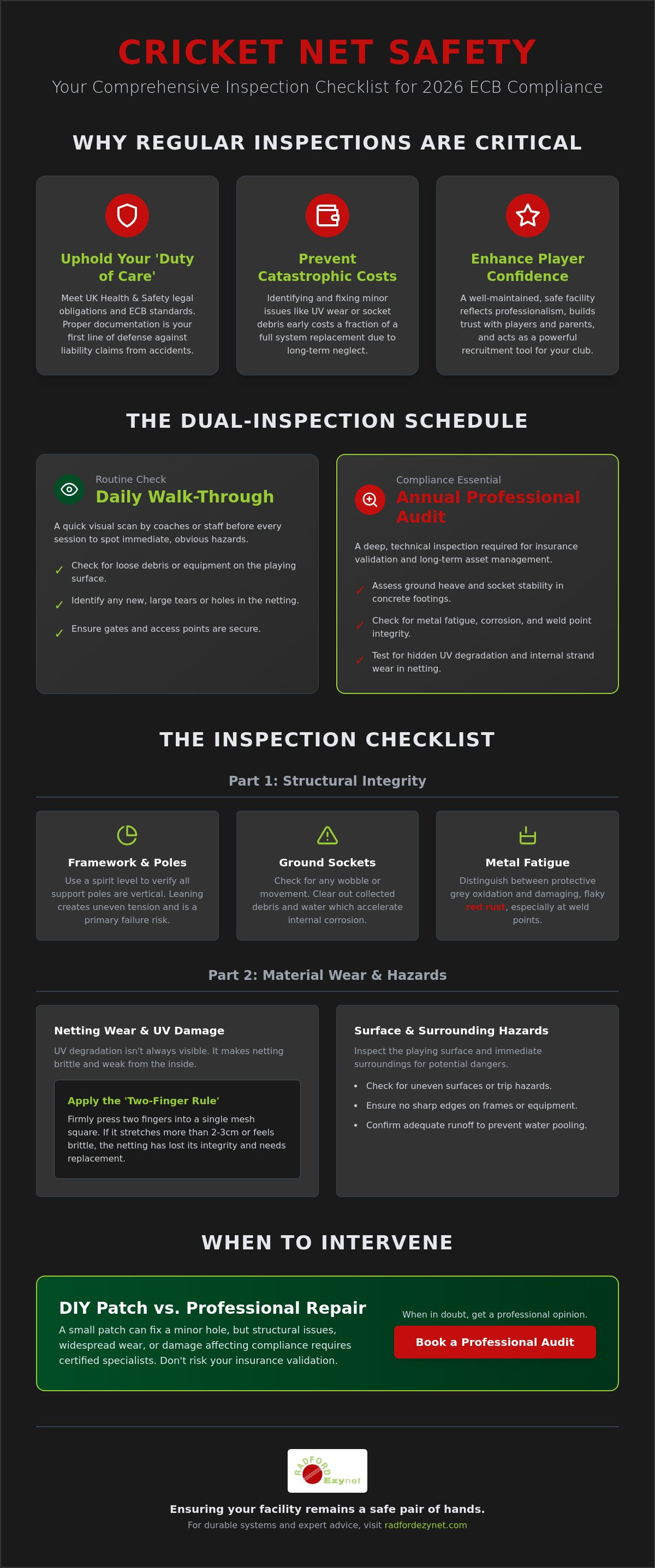
Safety is a shared responsibility that requires two distinct levels of oversight. A daily walk-through is a quick visual check performed by coaches or staff before a session begins. This focuses on immediate hazards like loose debris or obvious new tears. However, a professional annual audit is a technical deep-dive required for insurance validation. This audit examines ground heave, socket stability, and internal strand wear that the naked eye might miss. Adopting this 'Safe Pair of Hands' approach ensures your facility remains a secure, long-term investment for your players and meets all cricket net safety standards UK requirements.
Structural Integrity Checklist: Framework, Sockets, and Tension
Structural integrity is the silent guardian of any practice facility. While many safety guides focus on helmets or batting pads, the framework itself is what ensures a controlled environment. A robust inspection begins with the skeleton of the system. You should regularly verify the verticality of all support poles using a spirit level. Ground heave or impact leaning can subtly shift a pole over time, creating uneven tension that compromises the entire structure. This is a critical step in adhering to cricket net safety standards UK, as a leaning post can lead to unpredictable ball behavior.
Ground sockets require equal attention. These often collect debris, water, or organic matter that accelerates corrosion from the inside out. Ensure sockets are clear and that there is no movement within the concrete footings. Any wobble here suggests a failure in the foundation that a simple net replacement cannot fix. For those seeking a system designed for longevity and ease of maintenance, the Radford EZY Net System™ offers a durable solution that simplifies these structural checks by design.
Assessing Metal Fatigue and Corrosion
Outdoor structures face the relentless UK weather. It is vital to differentiate between surface oxidation and structural 'red rust' on galvanised steel. Surface oxidation is often a dull grey film that actually protects the metal. Red rust, however, is flaky and indicates that the steel is losing its structural properties. Pay close attention to weld points on bespoke cage systems; these are high-stress areas where hairline fractures can develop under heavy wind loading. Permanent outdoor structures act like sails during storms, placing immense pressure on every joint and fixing.
Wire Tension and Net Suspension Standards
Proper net suspension is critical for maintaining a secure environment. Top-wire tension must be taut enough to prevent the net from sagging or 'billowing' into adjacent lanes. Loose netting allows the mesh to move too much upon impact, increasing the risk of dangerous ball ricochets or interference with players in the next bay. This tension is a core component of cricket net safety standards UK compliance.
- Check mechanical fixings: Inspect all shackles, bolts, and carabiners for signs of fatigue, thinning, or distortion.
- Environmental weight: Identify worn carabiners that may snap when the net is weighted down by heavy rain or unexpected late-season snow.
- The Correct Drop: Ensure the net maintains a consistent 'drop' to the ground, preventing balls from escaping underneath the perimeter and entering spectator areas.
Maintaining these tension levels ensures that the kinetic energy of the ball is absorbed safely. It keeps every session predictable and secure, allowing coaches and players to focus entirely on their performance without worrying about structural failure.
Identifying Material Wear: Netting and Surface Hazards
While the structural frame provides the essential skeleton of your facility, the mesh and the playing surface are the front-line components that endure the most direct impact. Maintaining cricket net safety standards UK requires a vigilant eye for material degradation that often begins at a microscopic level. It's easy to overlook small tears, but these are the very points where a high-velocity ball is most likely to cause a total mesh failure. A systematic audit of these materials ensures your facility remains a safe environment for every session.
One of the most reliable methods for assessing immediate risk is the 'Two-Finger Rule'. If you find any hole in the netting that allows two fingers to pass through easily, the mesh has lost its ability to reliably contain a ball. These gaps require immediate repair or a section replacement. Don't ignore the base of the nets either. Foxes and rabbits often chew through the netting during the winter months, creating large entry points at ground level. These gaps are particularly dangerous as they allow balls to escape the lane at high speed, potentially entering spectator areas or adjacent walkways.
The playing surface itself must be part of your structural audit. Artificial surfaces should be inspected for 'bubbling' or seam separation. These aren't just aesthetic flaws; they're genuine trip hazards that can lead to serious injury during high-intensity training. Ensuring the junction between the artificial surface and the surrounding natural grass is flush is essential for preventing ankle injuries and maintaining a professional standard.
In addition to facility safety, player welfare is paramount; for those recovering from sports-related injuries, RED Physiotherapy provides specialist rehabilitation and support to help athletes return to the field safely.
UV Damage and Tensile Strength Testing
UV degradation is a silent threat to outdoor facilities. Over time, sunlight breaks down the molecular bonds in nylon or polyethylene netting, making the strands brittle. If your netting looks significantly faded, it's often a sign of major tensile strength loss. You can perform a simple 'snap test' by pulling on individual strands in high-exposure areas. If the material snaps easily rather than stretching, it's time to consider a replacement. High-grade, UV-stabilised netting systems offer the best long-term protection against the UK’s unpredictable climate, ensuring the mesh stays supple and strong for years.
Artificial Pitch Levelness and Seam Security
A safe lane depends entirely on a level, predictable base. You must check for 'hollows' or depressions in the sub-base that cause dangerous and unpredictable ball deviations. A ball that hits a hollow and pops up unexpectedly is a major risk to a batsman's safety. For a deeper look at how to manage these specific issues, our guide to artificial cricket surface maintenance provides technical insights into performance and longevity. Regular seam security checks prevent the carpet from lifting, which is the most common cause of trips and falls in the practice area.
Establishing an Inspection Schedule and Safety Documentation
A consistent inspection schedule transforms safety from a reactive chore into a reliable management system. To meet cricket net safety standards UK, you must go beyond occasional repairs and move toward a methodical rhythm of oversight. This structured approach ensures that structural integrity and material health are monitored throughout the entire lifecycle of the facility. It provides peace of mind for staff and a secure environment for players, regardless of how often the lanes are used.
The foundation of this schedule is the Pre-Season Audit. This is a technical deep-dive conducted before the first ball is bowled each spring. It identifies any damage caused by winter weather, such as ground heave or metal fatigue in the framework. Following this, weekly operational checks should focus on high-traffic areas. You'll want to pay close attention to the netting at the batting end and ground-level mesh where balls impact most frequently. Post-storm inspections are also vital in the UK. High winds can loosen mechanical fixings, while heavy snowfall can stretch or tear netting under the cumulative weight.
Inspection Frequency Based on Facility Type
Frequency requirements often depend on the specific environment of your nets. School facilities require daily visual checks during term time because of the intense, daily volume of student usage. In a club setting, weekly inspections by a groundsman or first-team captain are usually sufficient to maintain standards. However, public access nets present a unique challenge. These facilities are often subject to misuse or vandalism, making daily checks critical to mitigate liability risks and ensure the area remains safe for the community.
How to Document Findings for Insurers
Insurers require more than just a verbal assurance that checks were performed. They need a robust paper trail. We recommend using digital checklists that allow you to attach photo evidence for every structural inspection. This creates an indisputable record of your 'Duty of Care'. Your log should include a priority list that categorises findings into 'Immediate Action' for safety-critical repairs and 'Monitor for Future Repair' for minor wear. Linking these regular inspections to a professional cricket net upkeep service plan ensures your documentation is always ready for an audit and that your facility stays compliant with cricket net safety standards UK.
By maintaining a clear, evidence-based safety log, you protect your club from liability and extend the lifespan of your equipment. If you're ready to upgrade your practice environment with a system built for durability and ease of inspection, explore our professional cricket practice nets today.
Professional Intervention: When to Call the Cricket Net Specialists
Internal checklists provide a vital first line of defense, but there comes a point where specialist expertise is required to ensure a facility remains truly secure. Recognizing the limits of a DIY approach is a hallmark of responsible management. While a minor net patch might suffice for a small nick, it's no longer a safe solution once the material has reached the end of its functional life. Relying on temporary fixes for structural issues often leads to a false sense of security that fails to meet cricket net safety standards UK. When the integrity of the mesh or the stability of the frame is in question, professional intervention becomes essential.
Specialists offer a level of technical depth that internal staff simply cannot replicate. For schools, an independent, insured safety audit is particularly valuable. These reports provide the formal documentation required for local authority compliance and internal health and safety reviews. Furthermore, specialists can often identify a path for refurbishment rather than total replacement. By replacing only the fatigued components, such as top wires, carabiners, or ground sockets, they can extend the life of an existing frame for several years. This approach protects your initial capital investment while ensuring the facility remains a safe pair of hands for the community.
The Radford EZY Net Approach to Safety
With 40 years of experience in the industry, we've developed a keen eye for identifying hidden structural weaknesses that often go unnoticed during standard visual checks. Our process involves a thorough evaluation of every weld point and tension line to ensure the entire system operates as a cohesive, safe unit. We provide bespoke repair solutions that match the original system specifications, maintaining the structural harmony of the installation. This dedication to detail is why we've been trusted to support major clubs and international academies with safety-first installations that stand the test of time.
Next Steps for Your Facility
Taking action now prevents minor wear from escalating into a major safety breach or a costly emergency replacement. We recommend conducting an immediate walk-through using the checklist provided in this guide to identify any urgent concerns. Once you've completed your internal review, booking a professional audit is the best way to validate your safety logs and secure your insurance standing. If you've identified areas that require technical attention, contact our team for a professional cricket net repair service quote. Our experts will help you navigate the complexities of cricket net safety standards UK, providing a clear roadmap for maintenance or refurbishment that ensures your facility remains a dependable asset for many seasons to come.
Securing the Future of Your Practice Facility
Maintaining a high-performance training environment requires more than just high-quality equipment; it demands a commitment to ongoing vigilance. By implementing the 'Two-Finger Rule' for netting and conducting regular structural audits on framework verticality, you ensure your facility remains a safe space for every player. These proactive steps are the most effective way to align your club or school with the latest cricket net safety standards UK while protecting your long-term investment from premature failure.
When internal checks identify complex wear or structural fatigue, professional intervention provides the ultimate peace of mind. With over 40 years of industry experience and a history of providing insured maintenance contracts for international academies and prestigious clubs like Bath Cricket Club, we provide the technical depth needed for full compliance. Our methodical approach ensures no detail is overlooked, from ground socket stability to mesh tensile strength.
Take the next step in securing your facility's future. Book Your Professional Cricket Net Safety Inspection with Radford EZY Net to validate your safety logs and protect your community. We look forward to helping you maintain a world-class practice environment for seasons to come.
Frequently Asked Questions
How often should a cricket net safety inspection be carried out in the UK?
You should carry out a full technical audit at least once a year, typically before the season begins in the spring. This annual deep-dive is a core part of maintaining cricket net safety standards UK. In addition to this, schools and clubs should perform weekly visual inspections to identify immediate hazards like new tears or loose fixings caused by high-usage sessions or adverse weather.
What are the most common signs of imminent cricket net failure?
Common signs of imminent failure include ground heave around support sockets, visible red rust on galvanised steel, and netting that feels brittle to the touch. You should also watch for 'billowing' mesh or sagging top wires. These indicators suggest that the system can no longer absorb the kinetic energy of a ball safely, posing a risk to players and spectators alike.
Is it better to repair a hole in the net or replace the entire section?
It is better to repair a hole if it is an isolated incident and the surrounding mesh remains supple and strong. We recommend the 'Two-Finger Rule' for these assessments. However, if the netting is faded and brittle from UV exposure, a patch won't hold under pressure. In these cases, replacing the entire section is the only way to ensure structural reliability and player safety.
Does the ECB require formal safety inspections for club practice nets?
The ECB issues safety guidelines that all affiliated clubs are expected to follow to maintain a secure environment. While the ECB provides the framework, the legal responsibility falls on the club's 'Duty of Care' under UK law. Formal inspections are often a prerequisite for obtaining ECB funding or satisfying the requirements of sports-specific insurance policies in the UK.
Can I perform a safety inspection myself or do I need a professional?
You can perform routine visual checks yourself, but a professional is required for structural audits and insurance-ready documentation. A specialist possesses the technical tools to detect metal fatigue and foundation movement that aren't visible to the naked eye. Relying on a professional ensures your facility meets all cricket net safety standards UK and provides a secure, long-term record for your club.
What should I do if I find a structural crack in a support pole?
If you find a structural crack in a support pole, you must decommission the lane immediately to prevent injury. A crack indicates a failure in the metal's integrity that could lead to a sudden collapse under wind load or ball impact. Contact a specialist to evaluate whether a bespoke weld repair is possible or if the entire pole requires replacement to restore stability.
How does UV light affect the safety of my cricket netting over time?
UV light breaks down the molecular bonds in synthetic fibers, causing them to lose their tensile strength and become brittle. This process makes the netting prone to snapping upon ball impact. Regular testing of strand flexibility is essential, as even netting that looks intact may fail to contain a high-velocity ball if UV damage has compromised the material's internal structure.
What are the specific safety requirements for school cricket net installations?
School installations must adhere to strict health and safety documentation that prioritizes pupil protection and risk mitigation. This includes daily visual checks during term time and ensuring that the netting base is secure to prevent balls from escaping into common school areas. Schools often require independent safety audits to satisfy local authority compliance reports and internal risk assessments.


